
Does it Matter What Happens In A Church Service?
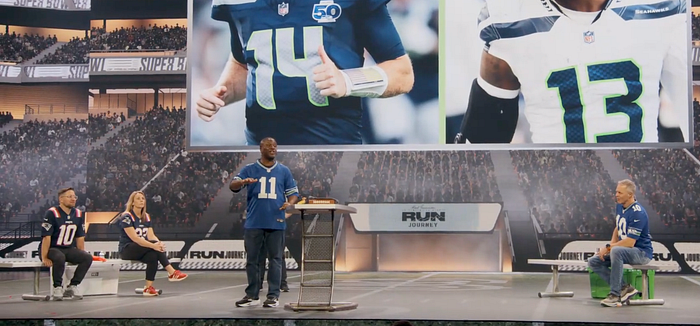
If you spent the next few months visiting a different church every Sunday, you would encounter a remarkable variety of services. Some would feature praise bands singing popular songs from Bethel, Hillsong, or Elevation, others would sing from a hymnal. The sermons at some Churches would feature verse-by-verse exposition, others a topical message addressing a current issue; you might even find video presentations in replacement of a sermon. You are also sure to encounter Churches with a medieval liturgy, complete with candles, incense, and iconography. If you visited Crossroads Church in Cincinnati, Ohio, last Sunday, you would have found the opposite: a Super Bowl–themed service featuring “commentators,” “refs,” and a football-themed message delivered by pastors dressed in game-day attire.
Faced with this range of possibilities, what conclusions can be drawn? Few would argue that every detail must be fixed and unalterable. Yet the more common assumption today is that none of it really matters, so long as people are being saved — or at least not offended.
The real question, however, is this: what does the Bible say about worship? Does Scripture provide guidance for how the church is to gather, or is corporate worship primarily about what makes us feel most connected to God?
It may be helpful to begin by asking why Crossroads’ themed, entertainment-oriented approach is so common. I think we see this approach because it typically does lead to more visitors. The logic is straightforward and often well-intended: people are hesitant to enter unfamiliar religious spaces, but they may come if the environment feels accessible, relevant, and non-threatening.
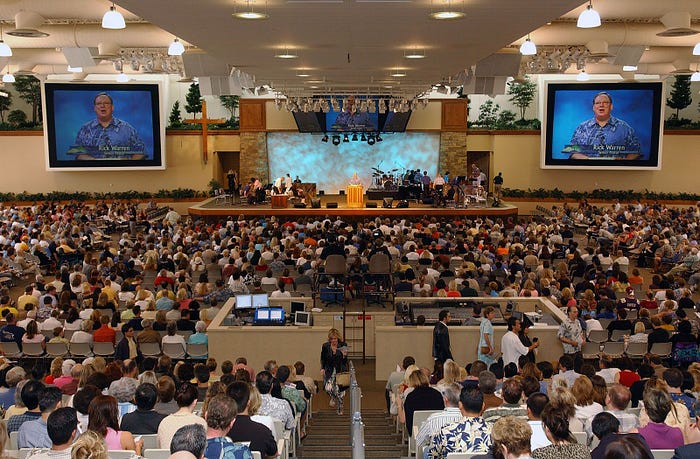
This approach is not new.
Pastor Rick Warren, in planting Saddleback Church, famously went door to door asking unchurched people why they did not attend church. Based on those answers, he structured Saddleback’s services and ministry approach with the unchurched explicitly in mind.
That philosophy went on to shape what became known as the seeker-sensitive model, influencing countless churches across North America.
The idea seems compelling. It feels loving, missionary-minded, and practical. If the goal is to reach people, why not remove unnecessary barriers? Why not speak the cultural language people already understand?
Yet the question that must be asked is not whether this strategy feels persuasive, but whether it fits with what Scripture teaches about worship. It is so easy for Christians to trust their intuition or tradition over God’s Word.“I love my Pastor and the people I worship with and the way we worship, why does anything else matter?”
God’s Holiness and the Boundaries of Worship
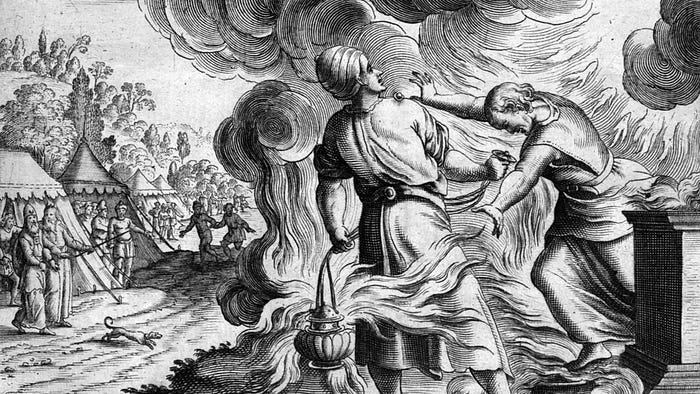
I remember how shocked I was the first time I encountered the account of Nadab and Abihu. Two priests offer unauthorized fire before the Lord, and they are immediately killed. The judgment feels severe and sudden. No warnings. No second chances.
Yet the point of the passage is unmistakable: God’s holiness places real boundaries on how He is to be worshiped. Nadab and Abihu are not charged with idolatry or malicious intent. They are judged for offering what God had not commanded.
There is a reason why stories of God’s judgment are not preached on in many churches; they make us uncomfortable. They don’t feel very nice. This passage in particular offends our modern sensibilities because Nadab and Abihu are at the very least worshipping the right God.
Even back at Sinai we see God’s love for the Israelites in His willingness to dwell and meet his people at their level (this is known as God’s “condescension”) and yet God’s holiness cannot be ignored. The people are commanded to stay away from the mountain, lest they touch it and die.
Worship is not about how you, me, or Nadab and Abihu feel most compelled or comfortable to praise God, but it is firstly about honouring God in the ways he has prescribed in his Word.
God’s love and holiness are not competing attributes. They are equally essential. Indeed, it is precisely the love within the Trinity that resulted in the Father sending the Son to satisfy divine holiness on behalf of sinners. The cross does not relax God’s standards; it fulfills them.
Some may object that such severity was particular to the Old Testament, not the New. Yet the New Testament itself resists this conclusion. Scripture records divine judgments within the apostolic era, including the deaths of Ananias and Sapphira.
In 1 Corinthians 11, Paul not only rebukes the Corinthian church for abusing the Lord’s Supper; he draws a direct connection between their irreverent participation, with a recent influx of illness and death amongst the congregation. So judgement — even including death — occurs under the New Covenant.
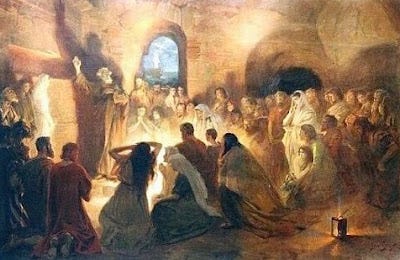
These passages certainly warrant believers to be prudent and respectful in how they worship. In my opinion, one way we can do this is by letting God, through the teachings of the New Testament, tell us how He ought to be worshipped.
Here is the pattern set forth in Scripture:
(1) Public Reading of Scripture:
In 1 Timothy 4:13 Paul exhorts Timothy to “devote yourself to the public reading of Scripture.” This establishes that Scripture is to be read aloud in the gathered assembly. While Paul initially has the Old Testament in view, Colossians 4:16 and 1 Thessalonians 5:27 instruct that apostolic letters also be read publicly.
(2) Preaching & Teaching:
In 2 Timothy 4:2 Paul commands, “Preach the word.” The gathered church is to receive authoritative proclamation and instruction from Scripture. Acts 20:7 provides an example of Paul preaching to believers assembled on the first day of the week, and 1 Corinthians 14:26 references teaching within the corporate gathering.
(3) Corporate Prayer:
Acts 2:42 describes the early church as devoted to “the prayers,” indicating structured, shared prayer within the assembly. In 1 Timothy 2:1–2 Paul calls for supplications, prayers, intercessions, and thanksgivings, and 1 Corinthians 14:16 assumes prayer being offered in the gathered church. Corporate prayer — adoration, confession, intercession, and thanksgiving — is therefore a clear element of worship.
(4) Singing:
In Ephesians 5:19 and Colossians 3:16 believers are commanded to sing “psalms, hymns, and spiritual songs.” 1 Corinthians 14:15 and 14:26 also reference singing in the assembly. Singing functions both as praise directed to God and as a means of teaching and encouraging one another.
(5) The Sacraments (Baptism and the Lord’s Supper):
In Matthew 28:19 Christ commands baptism, and the book of Acts repeatedly shows it administered in connection with the gathered church. In 1 Corinthians 11:17–34 Paul gives direct instruction for observing the Lord’s Supper when the church comes together, and Acts 20:7 links the breaking of bread with the assembly.
(6) Giving / Financial Contribution:
In 1 Corinthians 16:1–2 Paul instructs believers to set aside their contributions when they gather. 2 Corinthians 8–9 provides theological grounding for generous and orderly giving. Corporate financial contribution is therefore connected to the assembly.
Purpose and Manner of Worship:
Colossians 1:28 speaks of presenting everyone mature in Christ. Worship is therefore ordered toward mutual edification and spiritual maturity. Furthermore, 1 Corinthians 14:33 and 14:40 require that all things be done “decently and in order,” and Hebrews 12:28 calls for reverence and awe.
The New Testament therefore provides both the core practices that are to be done in worship — typically referred to as “elements” of worship — and the principles governing how they are to be practiced.
Someone might argue that there is room to add and remove elements, since the primary concern is what results in the most people getting saved.
However, the New Testament consistently treats offense — and the resulting rejection of God’s word — as an inherent, unavoidable feature of the gospel.
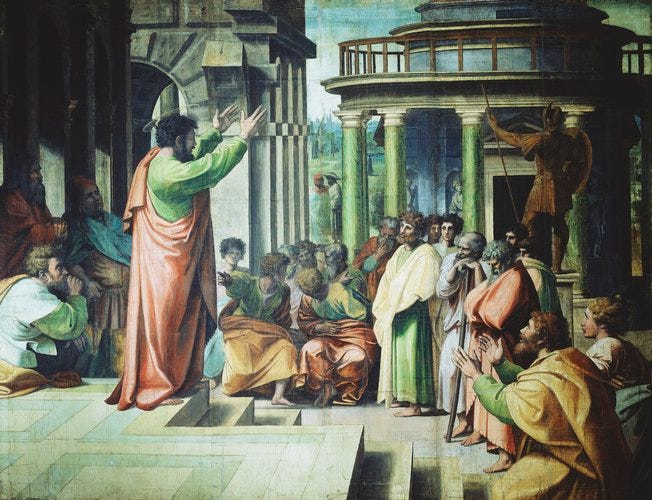
If Paul’s missionary journeys teach us anything, it is that people are not keen on the message of Christ (to put it lightly!). The message itself divides. Christ crucified is a stumbling block by nature, not by poor packaging. Claims about sin, judgment, repentance, and exclusive lordship confront human pride.
The apostles do adapt their language and strategies to some degree, yes. Paul reasons from the Old Testament when speaking to Jews in synagogues, but instead quotes Greek poets when speaking to Greeks in Acts 17. But resurrection, judgment, repentance, and allegiance to Christ are stated plainly, even when mocked or opposed.
God’s providence over reception is assumed. Mixed response is expected, not interpreted as a communications failure. Jesus’ parable of the sower and the repeated patterns in Acts present rejection as part of God’s design, not evidence that the message needs recalibration.
This does not mean that there is no room for variation in a church service. The Bible does not tell us how long a service ought to be, how many songs to sing, whether to include a piano, etc. And with this freedom, it may be prudent for churches to take cultural customs and the needs of their congregants into account. For example, if your local church is full of new believers, maybe going through a catechism would be a good use of time. If the surrounding culture does not typically wear suits and dresses, maybe it is better to dress in something different.
Ultimately, the apostles do not change and seek to “innovate” their worship services or even evangelism practices, because it is the Holy Spirit who opens and closes hearts. Changing the message or practices of the church does not purify the world; it just loses the message of the gospel. It is hard to ignore the repeating causal chain seen in many modern churches: more and more details of the worship are changed with the intention of saving more people, until what the church is saving people from is not even clear.
In some contexts, the impulse toward continual cultural accommodation has coincided with a weakening of historic Christian claims — particularly the conviction that salvation is uniquely found in Christ. Over time, exclusivist claims about the gospel can begin to sound negotiable rather than essential.
Worship is governed by fidelity, not outcomes. And the offense of the gospel for some is the power of salvation for others.
The Opposite Error
But like most things, there is an opposite error. Take, for example, a hospital that has had a number of patient deaths resulting from a sloppy and casual demeanor from its doctors and administration. The leadership responds decisively and introduces the following layers of compliance: fifteen years of licensing procedures to qualify as a surgeon; every new procedure requires a decade of committee review; and if something unexpected happens mid-operation, the surgeon must halt the procedure and submit documentation before deviating from the approved script. In the following years, the hospital’s deaths and injuries from lax standards are at an all-time low! But now the same number of patients are dying from the opposite problem: overregulation. Wait times stretch into years, patients die waiting for approval, and when complications arise during surgery, rigid protocol prevents timely intervention.
For many churches who see the problems with ignoring or replacing biblical worship elements for “more exciting” ones, there can be a temptation to try to add more order than what Scripture prescribes.
This response is common in Reformed circles. Appeals to doing all things “decently and in order” (1 Corinthians 14:40) have led to fully choreographed services, which include mandated form readings, fixed catechetical schedules, and near-uniform liturgies imposed across entire denominations.
The issue is not the use of things like forms, which can be pastorally wise. The issue is making policy where Scripture is silent.
This can also take root from a desire to be faithful to the Bible as a whole. Returning to Nadab and Abihu, they are punished for deviating from very detailed Levitical law. Under the Old Covenant, there was little to no room for interpretation or variation in how worship was done. There is no New Covenant version of Leviticus ironing out every last detail of how we ought to worship. Some Christians then try to construct one by looking between the lines of what the apostles said to try to figure out all of the details they surely intended to say.
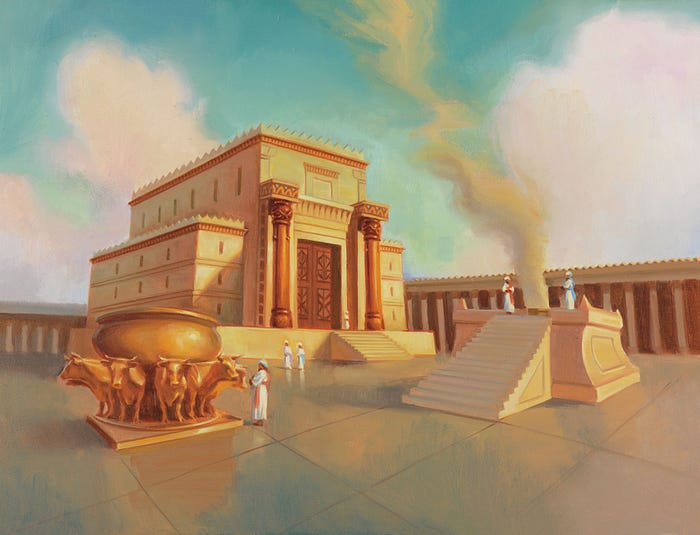
New Covenant worship does retain broad structural themes from Old Covenant worship, such as confession, sacrifice, communion with God, tithing, and blessing — this is significant. However, the book of Hebrews repeatedly insists that New Covenant worship is substantially different because it is no longer mediated through earthly types. The book of Hebrews is, in large part, an argument against what its original audience was tempted to do: return to earthly Levitical temple worship. While the book of Leviticus is usually not something most Christians find extremely interesting, tangible worship that involves all of the senses is something most people enjoy. Churches offer different flavours of sensory worship, whether it be the smells and bells of the Orthodox Church or the smoke machine and blasted praise band of Bethel. Our senses are important and by no means bad, but it is significant that we do not return to “mediated” worship. The finished work of Christ, as exposited in the preached Word, brings us something much greater than the visually stimulating worship the sacrifices brought to those under the Old Covenant.
Another important distinction is that while the terror of Sinai is a reflection of God’s holiness — and therefore has something to say about how we treat God with great reverence — it is also a reflection of something particular to the Old Covenant. The system implemented by Moses was mediated by flawed people and flawed sacrifices. Like getting close to the sun with something as insufficient as a fireman’s suit, the Old Covenant points to the sufficiency of Christ through the insufficiency of its priests, sacrifices, etc. While professing Christians should feel terror at the thought of denying Christ and thus trampling the blood of the covenant, they should approach with confidence, knowing the perfection of their priest.
All three of these distinctions between Levitical worship and New Covenant worship — the detail, the earthly types, and the insufficiency — should push churches away from trying to recreate such worship, what we might call Leviticalizing worship.
When a church insists that every last tradition, like priestly garments, made-up rituals, and icons of saints, are essential, they push not only toward a detailed form of worship that does not exist in the New Testament, but at the same time push away from the simplicity of biblical worship.
Ironically, both highly produced contemporary services and rigidly choreographed confessional or roman catholic services produce the same result: disengagement. When every detail is predetermined — whether to entertain or to feel safe — the congregation becomes passive. Worship shifts from participation to observation.
Finally one quick note on the normative principle.
The seeker-sensitive structure goes beyond the historic debate between those who argue that only what Scripture commands may be included in worship (the regulative principle) and those who argue that what Scripture does not forbid may be permitted (the normative principle). That debate, when conducted seriously, still assumes that Scripture is the governing authority. The seeker-sensitive model often shifts the governing authority from biblical warrant to measurable effectiveness.
In practice, when both normative and regulative principle views are held with integrity, the difference in actual worship services should not be extreme. If regulative-principle advocates are honest about the freedom Scripture allows in circumstances — such as time, order, instrumentation— they will not attempt to reconstruct a New Covenant Leviticus. And if normative-principle advocates are careful not to redefine or recreate elements themselves, they will not try to “innovate” worship.
The sharp divergence appears not primarily between careful RP and careful NP churches, but between Scripture-governed worship and outcome-governed worship.