
What Does the New Testament Say About “The Law”?

In Athanasius of Alexandria’s writings, he recounts a non-Arian resistance to applying the term homoousios (of the same substance) to Christ’s relationship to the Father. The concern was from some of the Eastern Bishops at the Council of Nicaea, and there objection to the term was not founded in a denial of Christ’s deity, but because they associated the Greek term homoousios with earlier modalistic uses of the word. They feared the term would result in collapsing the Father and Son into one person. Western bishops did not have a problem with using this term especially because the Latin translation, consubstantialis, did not carry the same modalistic associations. Ultimately, resolution came when the intended meaning of the Greek term was further clarified at the Council.
A similar dynamic appears in the Bible’s use of the law, where 7 theologians may give you 10 different possible associations with the phrase. Many theologians agree that “the law” can legitimately refer to God’s moral will, the Mosaic covenant, the Pentateuch as Scripture, or particular subsets of Mosaic legislation. Yet there is significant disagreement about which of these senses are intended in specific contexts. A major source of this disagreement is found in Paul’s letters, which contain the vast majority of the New Testament’s discussion of the Law and appear to speak of it in both strongly positive and sharply negative terms. This tension has proven difficult to resolve and has generated competing interpretations.

Here are a few examples:
“So then, the Law is holy, and the commandment is holy and righteous and good.” — Romans 7:12
“Nevertheless, knowing that a man is not justified by the works of the Law but through faith in Christ Jesus… since by the works of the Law no flesh will be justified.” — Galatians 2:16
“For we know that the Law is spiritual, but I am of flesh, sold into bondage to sin.” — Romans 7:14
“For the Law brings about wrath, but where there is no law, there also is no violation.” — Romans 4:15
“He who loves his neighbor has fulfilled the Law… Love does no wrong to a neighbor; therefore love is the fulfillment of the Law.” — Romans 13:8–10
“For if a law had been given which was able to impart life, then righteousness would indeed have been based on law.” — Galatians 3:21
The tension here should be self-evident. Wouldn’t you like to meet with Paul for coffee and ask him some questions about these verses? I would!
The solution, I would argue, is found by asking which proposed meanings of “the law” best fit the immediate and broader contexts of Paul’s argument.
In this respect, I have found the work of T. David Gordon and Douglas Moo particularly helpful. Moo argues that ὁ νόμος most often denotes the Mosaic or Sinai covenantal order. This reading is grounded in the way Paul consistently locates “the law” within redemptive history. Paul can describe the law as something that “entered” (Rom. 5:20) or was “added” (Gal. 3:19), language that presupposes a definable historical arrival. Unlike God’s moral will, which has always existed, the Mosaic covenant came into existence at a particular point in salvation history. Galatians 3:17 is especially clear: The Law, which came 430 years later, does not invalidate a covenant previously ratified by God.”
Building on this, Paul frequently treats νόμος (law) as an Israel-delimiting jurisdiction. Jews are described as those “under law,” Gentiles as those “without law,” and believers — whether Jew or Gentile — as those who have died to the law. One clear example appears in 1 Corinthians 9:20–22.
Here we will substitute the word law for two proposed meanings, the first is “God’s moral law.”
To the Jews I became as a Jew, so that I might gain Jews; to those who are under [God’s moral law], I became as one under [God’s moral law], though not being under [God’s moral law] myself… to those who are without [God’s moral law]… though not being without the law of God but under the law of Christ…
In what sense, then, is Paul no longer under God’s moral law? One might say he is no longer under its condemning power, but this raises a further difficulty: in what sense are Jews under God’s moral law in a way that Gentiles are not?
By contrast, when “law” is read as the Mosaic covenant, the passage reads naturally:
To the Jews I became as a Jew, so that I might gain Jews; to those who are under [the Mosaic covenant], I became as one under [the Mosaic covenant], though not being under [the Mosaic covenant] myself… to those who are without [the Mosaic covenant]… though not being without the law of God but under the law of Christ…
I cannot survey all relevant passages here, but I will post several more articles on this page showing this in the books of Romans and Galatians.
Some interpreters suggest that Paul is referring narrowly to ceremonial law in passages like 1 Corinthians 9. However, in the broader Pauline argument the law is consistently treated as a comprehensive covenantal package. The Mosaic covenant functions as a single reality, even though it contains many components. Much like a loan agreement with interest rates, penalties, and repayment terms, the covenant is entered into and administered as a unified whole.
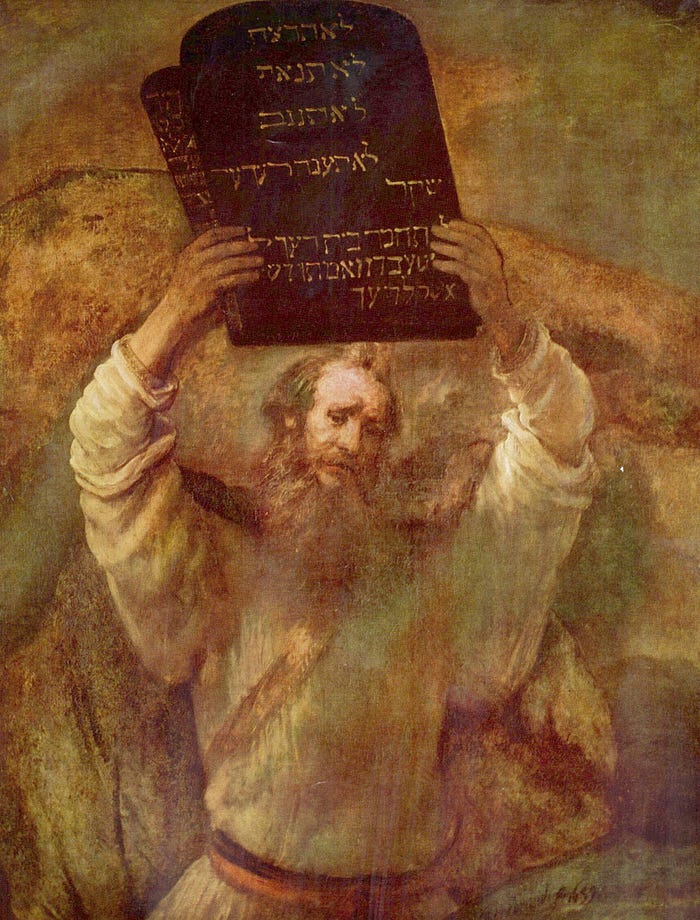
T. David Gordon likewise argues that Paul uses the term “law” (νόμος) as covenantal shorthand, such that it can refer to the Mosaic covenant as a whole rather than merely to individual commandments. This is analogous to a phrase like “all hands on deck,” which refers not merely to hands, but to the sailors themselves. In both cases, a part is used to represent the whole — a figure of speech known as synecdoche. “The Law” functions as a synecdoche for the Mosaic covenant because the covenantal administration itself is fundamentally defined by the giving of laws (traditionally numbered at 613).
At this point, maybe this debate between νόμος referring to “God’s moral law” vs “the Mosaic covenant” feels like the sort of techinical correction your great-aunt once made when you said, “I’m doing good,” and she insisted that you say “I’m doing well” instead.
For starters this seemingly small change in meaning explains the why we find both positive and negative statements about the Law in the New Testament. The disharmony of these passages is explained by the tension in the Mosaic covenant itself.
For example, the Law advanced God’s promise to Abraham by marking off Israel as a distinct covenant people through whom the promised Seed would come, preserving both lineage and true worship amid pervasive idolatry. Yet that same separation temporarily restricted covenant membership along national and cultic lines, postponing the full realization of the promise that all nations would be blessed through that Seed. Likewise, the priesthood and sacrifices were divinely instituted and pointed to the need for atonement, yet their continual repetition exposed their provisional and shadow-like character.
But perhaps the greatest tension in the Law, which has the most relevance for understanding the NT’s commentary about it, is that the Mosaic covenant could define righteousness, but could not produce it.
When I worked in the oilfield, I got to experience how extensive and detailed safety policies of various companies are; and yet injuries and deaths still continue to occur. The policies are not useless, but they do not guarantee safe practice.
Paul can therefore say that “the Law is holy, and the commandment is holy and righteous and good” (Rom. 7:12). Yet as Hebrews 8 explains, “If the first covenant had been faultless, there would have been no occasion for a second” (Heb. 8:7). The bad news of the Law, is that more than just defining what is righteous; it requires it, to the jot and tittle. The book of Deuteronomy for example, has an extensive list of commandments, which is followed by a list of blessings for the one who obeys and a much lengthier list of curses for the one who does not obey. But as Paul writes, “Cursed is everyone who does not abide by all things written in the book of the law, to perform them” (Gal. 3:10). The blessings may be offered, but we are not good enough to get them by our own work.
The good news of the gospel is that these covenantal curses — first incurred under Adam and then formally reiterated at Sinai — are ultimately borne by Christ: “Christ redeemed us from the curse of the Law, having become a curse for us” (Gal. 3:13). And on top of that greater blessings are won for us by His active obedience.
Here then is the fundamental place that the Mosaic Covenant and New Covenant are opposed. Paul summarizes this Mosaic principle with Leviticus 18:5: “The man who practices the righteousness which is based on law shall live by that righteousness” (Rom. 10:5). Blessing and life is attained not by believing and trusting, but by doing.
This verse does not describe salvation history as a whole, but the operative standard of the Mosaic covenant itself. As Galatians 3 makes clear, this law-principle never replaced the Abrahamic promise:
The Law, which came four hundred and thirty years later, does not invalidate a covenant previously ratified by God (Gal. 3:17).
The Abrahamic covenant therefore continued uninterrupted, so Old Testament believers — Jew and Gentile alike — were saved by virtue of the promise, not by adherence to the Mosaic Law. This continuity of the promise explains why Paul can speak so sharply about the Law without denying that Jews are saved by the same covenants of promise.

This defining-without-producing structure is not an inference imposed later by Paul; it is visible at Sinai itself. Israel stands before a holy God, hears the covenant stipulations, and promises obedience — “All that the LORD has spoken we will do” (Ex. 19:8) — yet boundaries are immediately established lest they die if they approach the mountain. From its inauguration, the covenant reveals both divine nearness and deadly distance: God descends in glory, yet whoever touches the mountain must perish. Even the cherubim overshadowing the ark echo the guardians of Eden, signaling that though God dwells among Israel, the barrier erected by sin has not yet been removed.
With the end of the Mosaic Covenant, do we then lose all of the positive qualities? No, rather the moral core of the Law expressed in various commandments, continues since it is based on God’s eternal character. These moral standards are repeated and internalized under the New Covenant apart from the works-based principle and resulting condemnation of the Mosaic administration.
Paul can therefore say that love fulfills the Law (Rom. 13:8–10), not because the Mosaic covenant continues unchanged, but because its moral center is taken up within a different covenantal framework. Ultimately God’s moral law did not begin at Sinai and therefore does not end at Sinai, but continues in another covenantal form.
So the positive and negative aspects of the Mosaic covenant explain the positive and negative statements the NT authors make about “the Law.”
Conversely if these passages are instead understood as a general reference to God’s commandments or His moral will a number of exegetical problems arise. Statements such as “the law is not of faith” do not make a lot of sense, since in what way do God’s commandments oppose faith in Him?
Additionally if Paul were contrasting commandments with faith in passages like Galatians 3, it would be difficult to explain why the same letter contains a substantial number of imperatives addressed to Christian churches. Paul clearly can command and exhort without thereby placing believers “under law.”
Under the New Covenant, faith is the basis of our salvation, but works are not removed from “the equation” per se because they are part of what we are saved unto.
Ephesians 2:10 For we are His workmanship, created in Christ Jesus for good works, which God prepared beforehand so that we would walk in them.
The opposite problem can also arise from assuming “the law” equals commandments. Fearing antinomianism or excessive discontinuity, interpreters often soften Paul’s language, bypass it, or force unnatural readings. Some interpreters for example read the same passages (Galatians 3/Romans 10), not as a contrast between law and gospel, but between a misinterpretation of the law and a true understanding of the law.
A similar unnatural reading of these sorts of passages can be seen in Douglas Wilson’s writings here:
“The unregenerate heart sees all of Scripture as condemnation, both law and gospel. The gospel message is heard as law, as another demand that must be met. The regenerate heart, on the other hand, sees Christ throughout the Scriptures, and receives even the law as a gift from God.”
There is some truth to the idea that the regenerate and unregenerate experience God’s revelation differently; yet this does not, by itself, resolve the exegetical question Paul is addressing. Paul’s law–gospel contrast is not merely a contrast in perception, but one grounded in redemptive history and covenantal structure. His argument turns on the objective difference between a covenant that promises life on the basis of obedience and a covenant that grants righteousness and inheritance through faith in Christ.
Understanding “the Law” to mean Mosaic Covenant therefore helps prevent reading the New Testament in a way that turns into antinomianism or blurs the law-gospel distinction.
The promises of the law are conditional, for they depend on the condition that we fulfill the law; but the promise of the gospel is free and rests solely on God’s mercy.
(Institutes, 2.7.4)
The law promises life upon condition of perfect obedience; the gospel, on the other hand, promises life freely for the sake of Christ, by faith alone.
From Ursinus’s Commentary on the Heidelberg Catechism: