Where Two Kingdoms Goes Too Far
How should the church, broadly, and Christians specifically, interact with the surrounding culture?
This is a question many Christians have wrestled with deeply and earnestly. I have written elsewhere addressing ideas from those who advocate applying Old Testament civil law directly to modern society (theonomy), as well as those who emphasize building parallel Christian institutions within the world (often associated with Kuyperianism or neo-Calvinism). In this article, I want to focus on what happens when one moves too far in the opposite direction.
I understand this position as being represented by some of the thinkers associated with what is often called radical two-kingdoms theology. This would include theologians such as David VanDrunen, Michael Horton, and D. G. Hart. Generally speaking, this label — commonly abbreviated as R2K — is often used less to clarify than to dismiss the ideas of these theologians on this subject. This is unfortunate, as these men offer real insight, and there is much to appreciate in their work.
More broadly, these types of labels (e.g., kuyperian, theonomic, two-kingdoms, etc.) represent tendencies of thought that fall on a spectrum rather than fixed systems. As a result, they can be useful shorthand, but they also risk flattening real differences, masking internal variety, and obscuring the many intermediate positions. That being said, “R2K” does represent a real and identifiable tendency within modern two-kingdoms thought, even if it is not a uniform system.
The Strength of the Two Kingdoms Distinction
With many two-kingdoms thinkers, I appreciate the effort to preserve the distinction between the gospel itself and the believer’s task of seeking the temporal good of the cities they live in. Both matter, and when they are blurred, the gospel can easily be reduced to a program of moral and social reform rather than the saving work of God, from which, through union with Christ, flows justification by faith and growth in holiness.
With the preservation of the gospel is also the preservation of the church’s ultimate calling and mission. As per 1 Corinthians 5, it is not to prevent the spread of immoral or unbiblical ideas within the broader culture, as though it could restrain the world from being the world. Rather, its primary task is the proclamation of the gospel — calling people to no longer be conformed to cultures set against Christ.
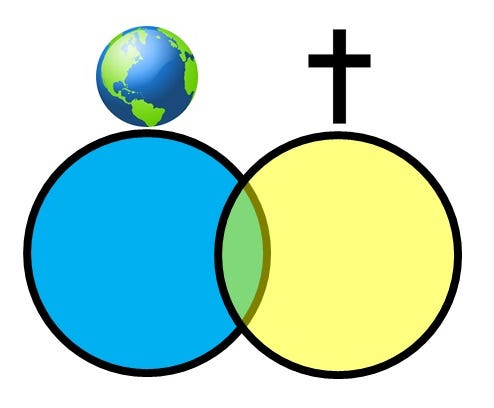
Another helpful emphasis from this perspective is that the civic (or common) realm and the redeemed realm serve complementary purposes. The civic realm, under God’s common grace, promotes order, justice, and the general well-being of society, while the redeemed realm advances through the proclamation of the gospel. These are not intrinsically opposing missions, but distinct ones, each operating according to their proper ends under God’s providence. They may at times come into tension, but this is not intrinsically. The church is not called to dominate or replace the civic realm; and vice-versa.
What Scripture Does (and Does Not) Address
But the two-kingdoms framework becomes unbiblical when it is made overly totalizing, as though politics were a sphere largely untouched by Scripture.
For example, D.G. Hart writes,
Jesus and Paul and Peter did not address politics — unless you want to talk about submission to the emperor and paying your taxes.
Hart elsewhere writes,
Because the Bible does not establish a specific form of government or prescribe public policies, the church has no authority to speak on political matters.
The difficulty here is that such claims depend heavily on how broadly one defines “politics.”
If by politics one means the detailed administration of civil society — questions of infrastructure, taxation, or regulatory policy — then it is true that neither Jesus nor the apostles provide direct instruction. Scripture does not function as a modern policy manual.
However, if “politics” includes the moral framework that undergirds public life, the claim becomes much harder to sustain. The New Testament speaks directly to issues such as sexual ethics, the sanctity of life, truthfulness, and justice. These have direct implications for how a Christian should view law and public policy in any society.
It is certainly true that pastors should not present their own prudential judgments on matters such as economic strategy, traffic design, or foreign policy as though they carried direct biblical authority. Do we really want churches dividing over debates on the efficacy of minimum wage laws?
But that is not the only category at issue. There are also major public questions that are moral in nature and therefore do fall under the authority of Scripture, even when they are fiercely contested in politics. Marriage, abortion, sexual ethics, theft, and justice are not merely topics of political disagreement; they are matters on which God has spoken.
Additionally, while the R2K school of thought rightly emphasizes that the redeemed and civic realms operate with different intended and complementary purposes, this is only one piece of the picture. The other piece is that these two realms clash, a lot.
Yes, civil society can accomplish real goods under God’s common grace, as Paul affirms in Romans 13, yet a culture composed largely of unredeemed people will inevitably be shaped by distorted moral and religious assumptions. In this sense, the surrounding culture does not remain neutral, but regularly presses against and seeks to distort biblical teaching. The book of Acts provides numerous illustrations of this conflict, as the proclamation of the gospel repeatedly brings the apostles into direct confrontation with surrounding governments.
The Problem of Emphasis
Dr. David VanDrunen is perhaps the most well-known proponent of the Two Kingdoms framework. He articulates a thorough vision of his ideas in his book, Living in God’s Two Kingdoms. His formulations on this subject are often careful and nuanced.
However, as I observed firsthand during my time at Westminster Seminary California and in interactions with pastors trained there — the actual ideas people come away with are a lot less nuanced.
Critiques of theonomy, fundamentalism, and political overreach were frequent and clear. By contrast, engagement with modern progressive movements, like marxism, critical race theory, and feminism were largely absent. A common refrain from pastors in the area was: “My church has both Democrats and Republicans.” While intended to preserve unity, this can ignore that many modern political positions involve moral claims that directly contradict Scripture.
I witnessed how many of the teachings from these ideologies seeped into congregations and the progression in individual Christians from becoming proponents of BLM to having pronouns on their social media pages. This is not to say these issues were never addressed, but the imbalance in emphasis was noticeable.
The result can be that pastors are highly alert to the dangers of politicizing the gospel, yet less prepared to confront competing moral and religious frameworks that happen to be labelled as just more “politics” or “culture wars”.
The answer is not for a congregation to become politically obsessed; constantly fixated on the moral disarray of the world. I have first hand witnessed pastors repeatedly condemn progressive ideologies that have zero influence in their church. But when Christians are influenced by the world and its ideas they will too become politically obsessed. So the Pastor’s job is not to stand up and condemn the ideas of Karl Marx every Sunday, but if they notice congregants are being influenced by the deeply religious ideology of marxism they ought to address this.
Shepherds must guard the flock from rival interpretive frameworks that challenge Christian truth. Christians who start reading the Bible through the lenses of oppressed and oppressor for example, will very likely soon view Christianity itself as a western religion of oppressors.
A More Balanced Approach
A biblically balanced understanding of the two kingdoms can hold several truths together.
(1) The theocratic nation of Israel under the Old Covenant was a temporary and typological arrangement, pointing forward to greater spiritual realities, as the New Testament — especially Hebrews — makes clear, rather than serving as a direct blueprint for how a modern political state ought to be constructed.
(2) With the coming of Christ, the kingdom of God is no longer tied to a particular nation, but is manifested in a people drawn from every nation, directing believers to seek a heavenly city rather than ultimate fulfillment in any earthly political order.
(3) Points 1 and 2 should not lead to political withdrawal, but to proper prioritization: Christ’s kingdom advances through the gospel and the Spirit, even as the world continues in patterns of sin and partial good under God’s providence. In this context, Christian engagement in public life is best understood as participating in God’s common grace — seeking the relative good of society in a fallen world, rather than attempting to realize a fully Christian social order in the present age.
(4) At the same time, the church must disciple believers in biblical ethics, which inevitably shape their lives in the world — including their political judgments. Because many modern political ideologies carry comprehensive moral and even quasi-religious visions of the world, the church must also be vigilant in guarding against their uncritical adoption, ensuring that believers are formed by Scripture rather than by competing frameworks.